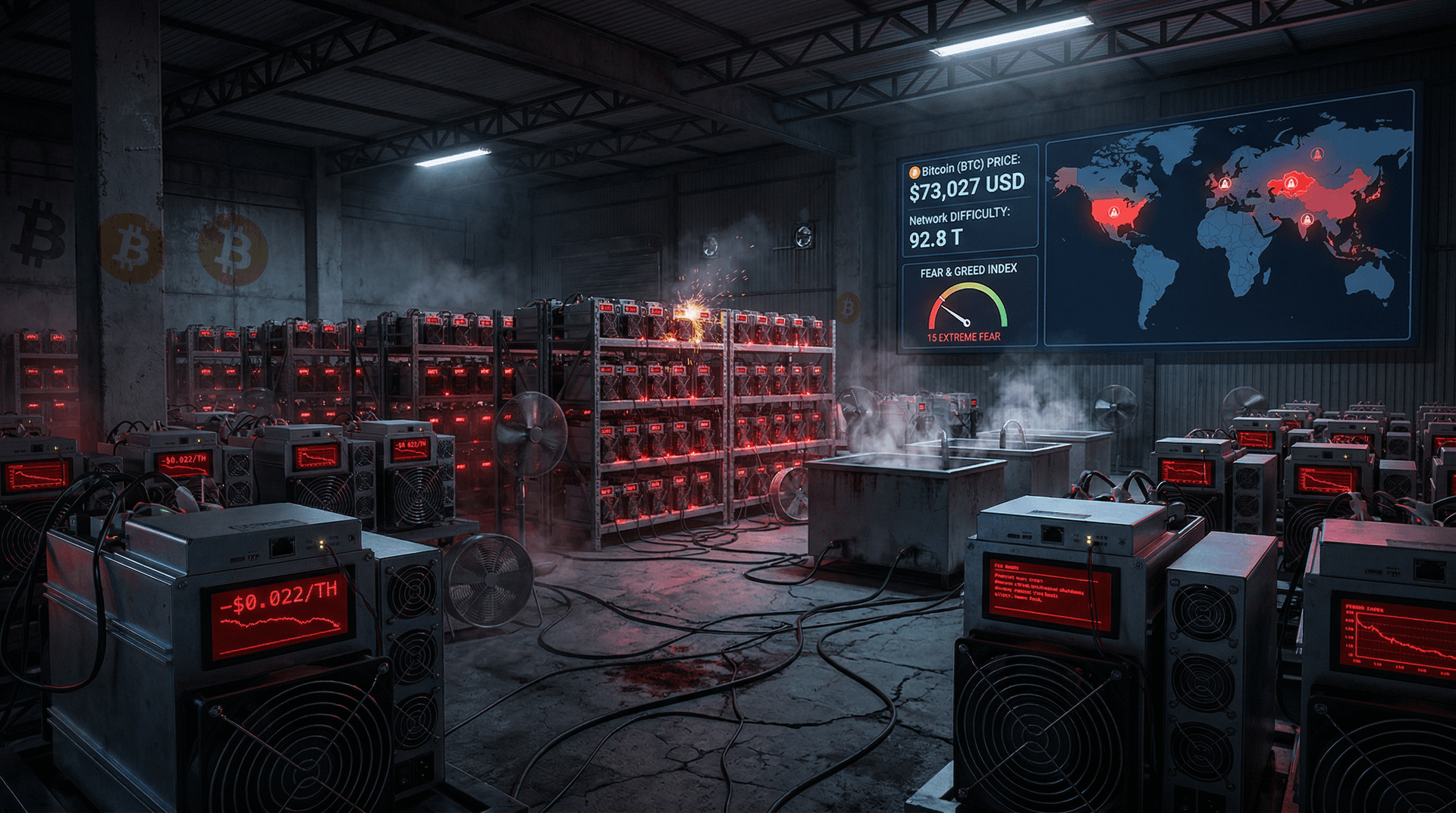
Bitcoin miners lose $0.022 USD per terahash (TH) daily on April 11, 2026. Network difficulty plunged 5.2% in 24 hours, according to Blockchain.com data. High energy costs still erase all revenue gains, thrusting operations into deeper losses.
Average revenue stands at $0.045 USD per TH, CoinMetrics reports. Electricity expenses hit $0.067 USD per TH based on $0.08 per kilowatt-hour (kWh). Bitcoin miners now operate far in the red, forcing tough financial decisions.
The Fear & Greed Index signals 15, extreme fear, per Alternative.me. BTC trades at $73,027 USD, up just 0.2% on the day.
Difficulty Drop Fails to Rescue Bitcoin Miners
Network difficulty fell to 92.8 trillion, Blockchain.com confirms. Hashrate dropped 8% to 650 exahashes per second (EH/s) over seven days. Rigs shut down across major hubs as unprofitable machines go offline.
Marathon Digital curtailed 45% of its fleet, revealed in Q1 2026 earnings on April 10. Core Scientific slashed 30% of operations, per SEC filings. Small operators abandon the space entirely, consolidating power among survivors.
Bitmain S21 miners generate $12.50 USD daily, Luxor Technologies data shows. Costs exceed $15 USD, including cooling overheads. Shutdowns accelerate, reshaping mining operations.
Energy Costs Crush Mining Profitability
Global energy prices surged 12% year-over-year, U.S. Energy Information Administration (EIA) data reveals. U.S. industrial rates average $0.082 USD per kWh on April 11. Texas grids strain under demand, hiking spot prices further.
Texas solar power costs $0.045 USD per kWh, but intermittency imposes 20% overhead, National Renewable Energy Laboratory (NREL) reports. Canadian hydro sources limit uptime to 60%, curbing output reliability.
AI data centers outbid Bitcoin miners for power. Microsoft secured 1.5 gigawatts (GW) in West Virginia on April 9. Miners now chase stranded energy sources or exit the industry altogether.
Halving Economics Hammer Bitcoin Miners
The 2024 halving cut block rewards to 3.125 BTC. At $73,027 USD per BTC, blocks yield $228,846 USD. Transaction fees add $5,200 USD average, Glassnode states.
Pre-halving blocks generated $450,000 USD. Miners once targeted $100,000 USD BTC prices for breakeven. Now, 85% of operations lose money, Cambridge Centre for Alternative Finance estimates.
Fees settled at $2.10 USD per transaction, Mempool.space shows. Ordinals and Runes hype spiked fees briefly in Q1 2026, but normalized levels expose vulnerabilities.
Public Miners Issue Dire Financial Warnings
Riot Platforms reported negative free cash flow in its April 10 release. Shares plunged 15% to $8.45 USD. CleanSpark idled 20% of its hashers to stem losses.
Hut 8 shifted to high-performance computing on April 11. It leases rigs to AI firms at $0.09 USD per TH/s daily. Pure-play Bitcoin mining fades as diversification rises.
Public miners hold 28,000 BTC worth $2.04 billion USD, Arkham Intelligence tracks. They sell 2,500 BTC daily, CryptoQuant reports, pressuring prices downward.
Tech Upgrades Provide Slim Hope for Bitcoin Miners
MicroBT's M63 achieves 23 joules per terahash (J/TH) efficiency in Q3 2026 launches. Current Bitmain S21 models lag at 17 J/TH. Upgrades cost $25 USD per TH upfront.
Immersion cooling cuts energy use by 30%, Applied Digital claims. Retrofitting demands $1.2 million USD per 10-megawatt (MW) site, delaying ROI.
Stratum V2 protocol decentralizes mining pools. Braiins now controls 15% of hashrate following April 11 upgrades, enhancing miner autonomy.
Miner Capitulation Ripples Across Crypto Markets
BTC holds at $73,027 USD. ETH climbs to $2,258 USD, while XRP reaches $1.35 USD. Key support lies at $68,000 USD, TradingView analysts predict.
BlackRock's IBIT ETF added 1,200 BTC on April 10, Farside Investors data shows. Grayscale faced outflows of 800 BTC, balancing inflows.
Market volatility intensifies as miner sales flood exchanges. Institutional buying counters some pressure, but fear dominates sentiment.
Efficient Bitcoin Miners Drive Industry Consolidation
Bitdeer reports positive EBITDA even at $60,000 USD BTC, per its April 11 statement. Paraguay facilities access power at $0.032 USD per kWh.
Top five miners command 65% of hashrate, BTC.com data indicates. TeraWulf pursues acquisitions, Bloomberg reported on April 11.
An 8% hashrate dip poses no security risk, Princeton University researchers state. Difficulty adjusts automatically every 2,016 blocks, stabilizing the network.
Bitcoin miners intensify lobbying for U.S. subsidies. A Texas bill advances to an April 11 hearing, promising tax breaks on energy-efficient rigs.