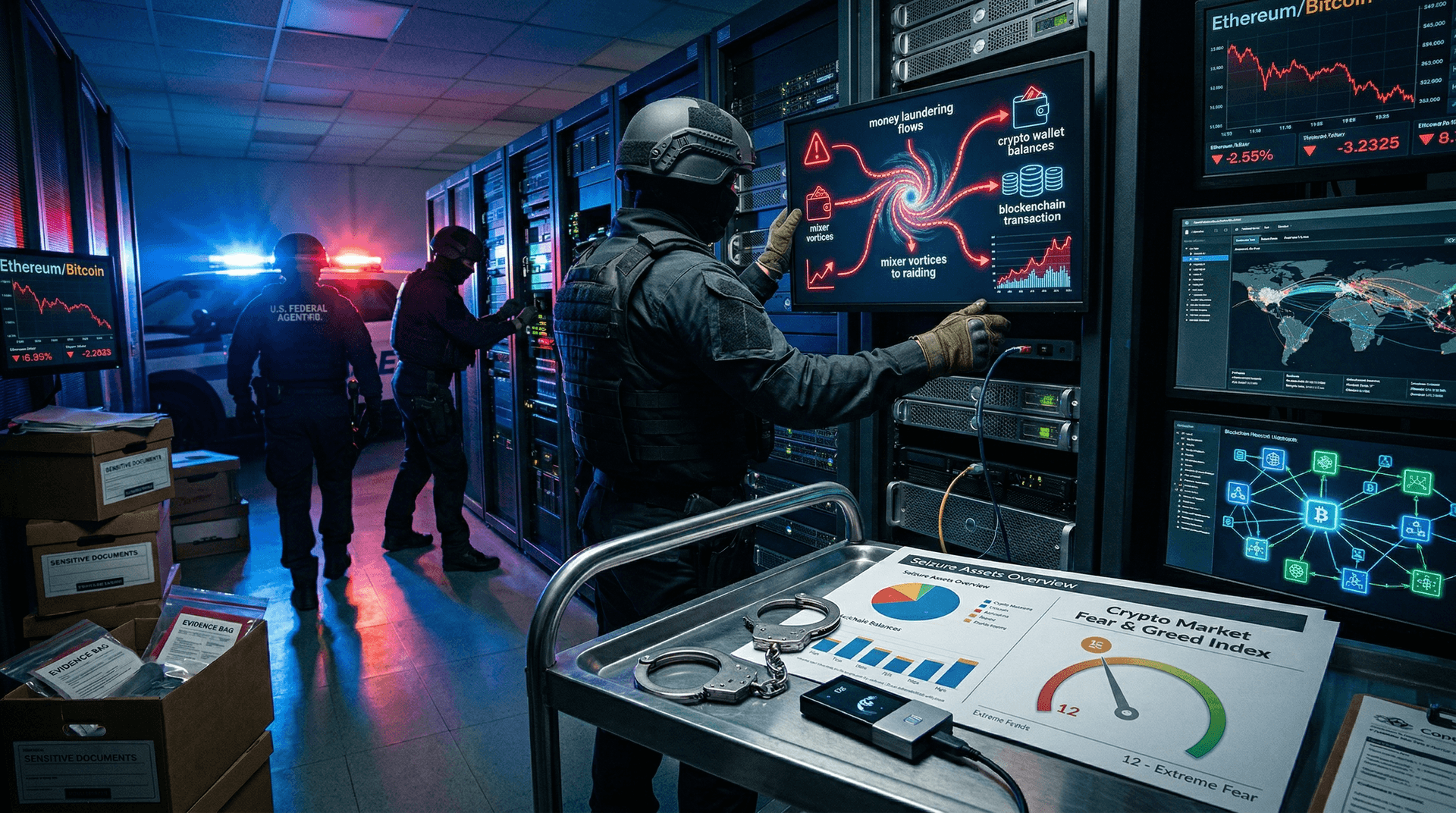
- U.S. authorities seized $2.3 million in crypto accounts tied to crypto money laundering on April 13, 2026.
- Crypto Fear & Greed Index falls to 12, signaling extreme fear after the bust.
- Bitcoin price drops 1.0% to $70,940 as markets react to enforcement action.
Key Takeaways
- U.S. authorities seized $2.3 million in crypto accounts tied to crypto money laundering on April 13, 2026.
- Crypto Fear & Greed Index falls to 12, signaling extreme fear after the bust.
- Bitcoin price drops 1.0% to $70,940 as markets react to enforcement action.
Federal authorities seized $2.3 million in cryptocurrency accounts linked to crypto money laundering on April 13, 2026. The U.S. Department of Justice announced the action.
Agents traced transactions across multiple blockchains using advanced analytics tools. Funds moved through privacy mixers and cross-chain bridges from ransomware attacks and darknet markets.
Damian Williams, U.S. Attorney for the Southern District of New York, led the probe. "Criminals exploit blockchain anonymity, but our transparency tools expose them," Williams stated in a DOJ release.
Crypto Money Laundering Targets Privacy Protocols
Investigators pinpointed 47 wallet addresses holding the $2.3 million. Most funds resided in Ethereum-based accounts, with $1.8 million in ETH valued at $2,192.61 per token. Smaller sums appeared in Bitcoin and XRP holdings.
The operation relied on advanced mixers similar to Tornado Cash forks. These tools obscure transaction links on public ledgers. Blockchain forensics firms like Chainalysis tracked the flows despite heavy obfuscation tactics.
Nicole Argent, Head of Financial Crime Investigations at Chainalysis, analyzed the case. "Privacy protocols enable 90% of detected crypto money laundering, according to our latest data," Argent told CoinDesk. Chainalysis software first flagged these wallets months earlier.
Authorities secured a court order to freeze the accounts. Prosecutors now pursue civil forfeiture under the Bank Secrecy Act. No arrests have occurred yet, but charges loom.
Blockchain Security Flaws Exposed
Public blockchains offer transparency by design. Yet privacy layers create regulatory blind spots that criminals exploit.
Developers created mixers to resist surveillance. Criminals adopted them rapidly for illicit finance flows. The U.S. Treasury sanctioned Tornado Cash in 2022, but copycat tools proliferate.
Major exchanges now demand proof-of-origin for deposits exceeding $1,000. Platforms ignoring these rules risk delisting from banking networks.
Nick Baker, Policy Editor at CoinDesk, weighed in on broader effects. "Seizures like this double on-chain scrutiny and impact legitimate DeFi users," Baker said in a Cointelegraph interview.
Tech firms such as Elliptic and TRM Labs provide real-time monitoring solutions. Traditional banks integrate these tools for secure crypto custody services.
Markets Tumble on News
Crypto markets reacted sharply to the news. The Fear & Greed Index, a sentiment gauge combining volatility, volume, and social media trends, plunged to 12—indicating extreme fear—per Alternative.me data.
Bitcoin traded at $70,940, down 1.0% over 24 hours. Ethereum slipped to $2,192.61. XRP fell 0.4% to $1.32; BNB eased 0.1% to $594.76.
CoinGecko data revealed trading volume spiked 25% amid searches for laundering-related keywords. Institutional inflows stalled at $450 million for the week, according to Glassnode metrics.
Traders eye Bitcoin support at $70,000. Ethereum derivatives point to $2,100 as a critical level for further downside.
Finance Sector Tightens Grip
The SEC investigates 12 similar crypto money laundering cases this quarter alone. The EU's MiCA regulations will ban mixers outright by July 2026.
Banks including JPMorgan and Goldman Sachs now verify all crypto deposit sources rigorously. Coinbase reported $5.2 billion in suspicious activity last year, per Chainalysis annual report.
Crypto insurers raise premiums on hot wallet coverage by 20%. Policies explicitly exclude funds linked to mixers.
DeFi platforms adapt quickly. Uniswap introduced optional KYC for swaps over $10,000. Aave mandates whitelisted assets for lending pools.
The $2.3 million seizure represents just 0.0003% of total crypto market cap, per CoinGecko. Such actions signal stronger enforcement and secure bigger budgets. Congress considers a $500 million fund for crypto crime investigations.
Crypto Money Laundering Implications for Adoption
Enterprises halt some blockchain pilots amid risks. Walmart advances supply chain tokenization but avoids payment applications. IBM noted a 15% drop in client blockchain inquiries after recent busts, per filings.
Venture capital shuns privacy-focused projects. Funding plunged 40% in Q1 2026, according to PitchBook data. Investors pivot to regulated stablecoins like USDT, stable at $1.00.
Central banks push CBDCs harder. The Federal Reserve tests a privacy-preserving digital dollar. The ECB aims for full rollout by 2028.
Blockchain's immutability aids law enforcement probes. Anonymity tools, however, sustain criminal activity. On-chain trading volume approaches $3 trillion monthly, per Dune Analytics.
Enforcement Outlook Ahead
Prosecutors aim to recover $10 billion in illicit crypto flows this year. International task forces exchange wallet intelligence. Interpol leads 22 cross-border operations.
Expect heightened blockchain security measures and account seizures. Bitcoin holds above $71,000 to spark a rebound; a break signals deeper correction.