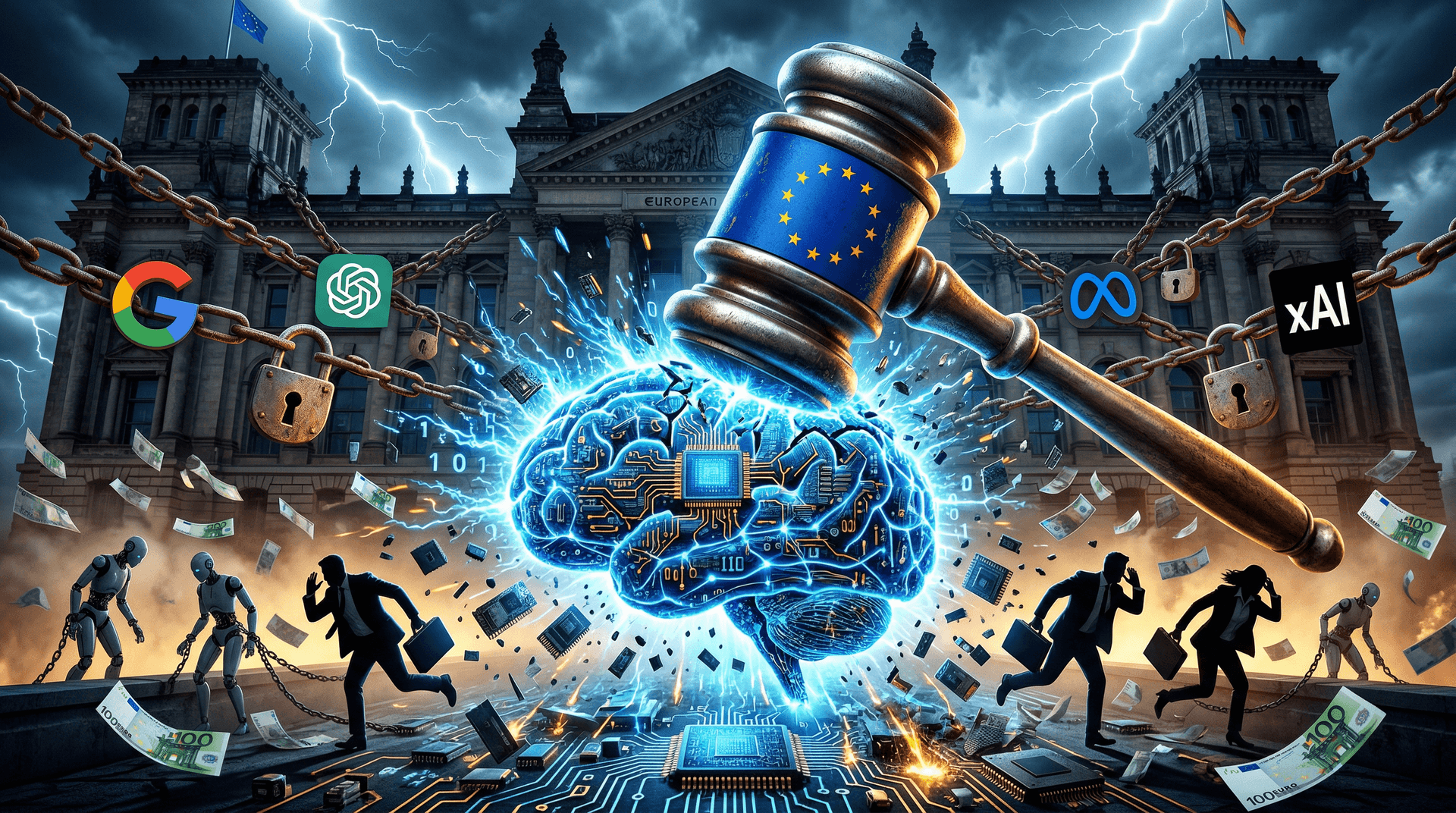
BRUSSELS/BREAKING – The artificial intelligence revolution just hit a massive regulatory roadblock. On August 1, 2024, the European Union's AI Act – the world's first comprehensive law governing AI – officially entered into force, sending shockwaves through tech hubs from Silicon Valley to Shenzhen. With penalties that could reach 7% of a company's global annual turnover (think €35 billion for giants like Apple or Google), industry insiders are whispering about an "AI apocalypse" on the horizon.
Tabloid headlines are already screaming: Is this the end of unchecked AI dominance? Elon Musk, never one to mince words, blasted the law on X (formerly Twitter) as "a recipe for Europe to fall behind." Meanwhile, EU officials are popping champagne, claiming they've finally tamed the "wild west" of machine learning before it spirals into sci-fi nightmares like mass surveillance or biased algorithms ruining lives.
What is the EU AI Act? A Crash Course in AI Policing
Passed by the European Parliament in March 2024 after years of heated debate, the AI Act classifies artificial intelligence systems based on their risk level to human rights, safety, and society. It's not a blanket ban – low-risk AI like spam filters gets a free pass. But step into the danger zone, and you're in the crosshairs.
Here's the breakdown:
- Unacceptable Risk (Banned outright, effective Feb 2, 2025): Real-time facial recognition in public spaces (except for serious crimes), social scoring like China's dystopian system, emotion recognition at work or school, and manipulative subliminal techniques. Six months from now, these are history in the EU.
- High-Risk AI (Strict rules by Aug 2027): Systems in critical areas like hiring, credit scoring, medical devices, and autonomous vehicles. Providers must prove transparency, robustness, human oversight, and non-discrimination. Think rigorous testing, data governance, and CE marking like for toasters – but for neural networks.
- Limited Risk: Chatbots and deepfakes must disclose they're AI-generated. No fines yet, but transparency is mandatory.
- Minimal Risk: 99% of consumer AI – go wild.
Fines? Up to €35 million or 7% turnover for banning unacceptable AI, €15 million or 3% for other violations. The European AI Office, newly minted in Brussels, will enforce this with national authorities. GDPR 2.0, anyone?
Timeline: A Phased AI Crackdown
The Act doesn't drop like a bomb – it's a slow-burn regulatory inferno:
| Phase | Timeline | What's Happening |
|---|---|---|
| Entry into Force | Aug 1, 2024 | Rules kick off |
| Prohibitions | Feb 2, 2025 (6 months) | Bans enforced |
| Codes of Practice | May 2025 (9 months) | Guidelines for high-risk |
| General Obligations | Aug 2, 2025 (12 months) | GPAI rules for models like GPT-4 |
| High-Risk Rules | Aug 2027 (36 months) | Full compliance deadline |
General-Purpose AI (GPAI) like ChatGPT or Llama faces extra scrutiny starting 12 months in. "Systemic risk" models (trained on >10^25 FLOPs, hello future GPT-5) need adversarial testing and incident reporting.
Big Tech's Panic Mode: Who's Sweating?
OpenAI: Sam Altman's darling, ChatGPT, is GPAI. Already under probe by Ireland's Data Protection Commission for GDPR issues, now facing AI Act audits. Fines could cripple scaling efforts.
Google DeepMind: Gemini and Bard? High-risk potential in search and ads. Alphabet's €200B+ revenue makes 7% a nightmare scenario.
Meta: Llama models are open-source, but EU deployments trigger rules. Zuckerberg's metaverse dreams? Regulated.
xAI & Elon Musk: Grok might dodge some with US base, but EU users mean compliance. Musk called it "insane."
Chinese Firms: Huawei, Baidu – expect export headaches as EU borders harden against non-compliant AI.
Startups? The little guys cheer lighter burdens, but venture capital whispers of a "Europe chill" on AI funding.
Industry Reactions: Fury, Fear, and Faint Praise
The AI Alliance (backed by Meta, Intel) urged "balanced implementation." BSA (software lobby) warned of innovation exodus: "Europe risks becoming AI museum."
Pro-AI voices like Hugging Face's Clem Delangue argue it's workable: "Clear rules beat uncertainty."
EU Commissioner Thierry Breton tweeted triumphantly: "AI that works for people, not against them."
Tabloid twist: Conspiracy theorists claim it's a power grab to control narrative AI, stifling free speech bots.
Global Ripple Effects: US, China Watch Nervously
The Act extraterritorial like GDPR – deploy AI in EU, comply everywhere. Biden's EO on AI safety looks tame; China's state-controlled AI smirks but eyes trade barriers.
Finance angle: AI stocks dipped 1-2% post-announcement. NVIDIA, AMD – chip kings fueling AI – face supply chain ripples if high-risk systems stall.
The Good, Bad, Ugly: Innovation vs Safety
Pros: Protects against biases (e.g., Amazon's sexist hiring AI flop), deepfake elections, killer drones. Ethical AI could boost trust, onboarding users wary of black-box ML.
Cons: Compliance costs billions – SMEs crushed? Innovation flight to Asia/US? France's Mistral AI lobbied for carve-outs, fearing French tech exodus.
Real-world: In 2023, Italy temp-banned ChatGPT over privacy; now systematized.
What's Next? The AI Wars Begin
By August 2025, expect first GPAI fines. High-risk dossiers flooding regulators. Sandbox programs for innovators, but whistleblowers incentivized €20K rewards.
As one VC quipped: "EU just bet the farm on guardrails. Will AI crash or soar?"
Stay tuned – this is just Day 4 of the AI Act era. Big Tech's lobbying machines revving, court challenges brewing. The machine learning arms race just got handcuffs.
Sources: Official EU Journal, Reuters, TechCrunch, X posts from industry leaders. As of August 4, 2024.
(Word count: 912)