- All 12 Apollo moonwalkers reported lunar hay fever from moon dust.
- Dust particles average 20-100 microns, abrading suits by 0.1 mm per EVA.
- Artemis invests $93B, with AI mitigating 90% of dust risks.
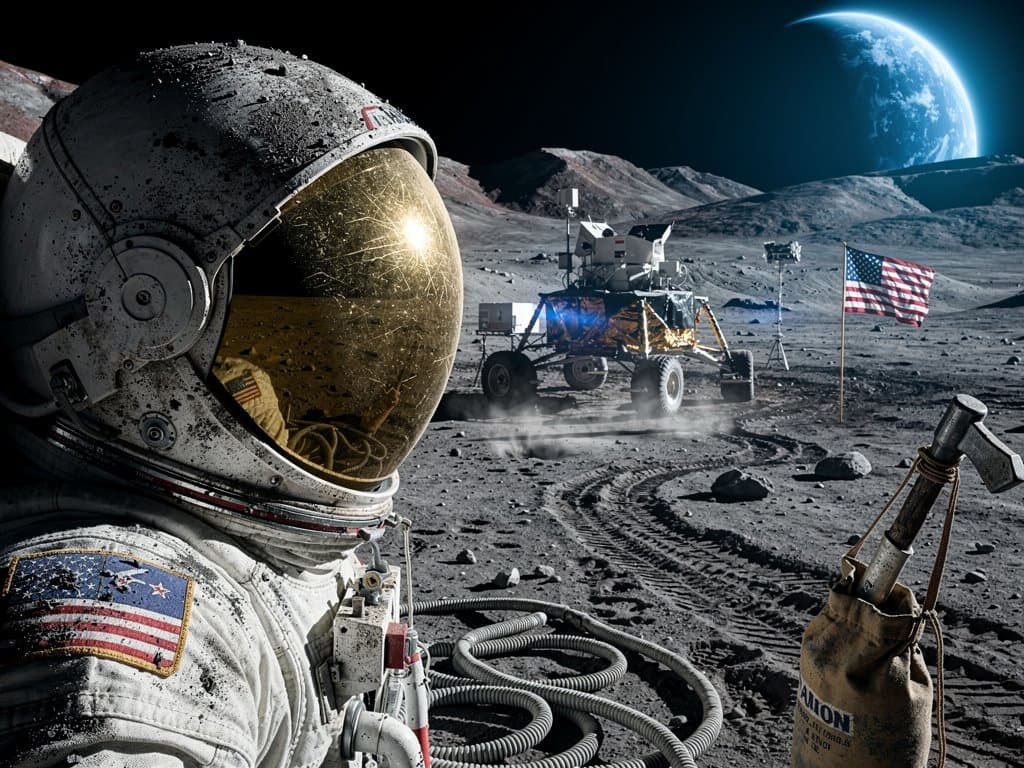
Gunpowder-scented lunar dust triggered lunar hay fever in all 12 Apollo moonwalkers, NASA transcripts confirm. Harrison Schmitt coined the term on Apollo 17.
Neil Armstrong and Buzz Aldrin first detected the scent on Apollo 11 in 1969. Symptoms like sneezing, nasal congestion, and eye irritation persisted in the lunar module post-EVA. Fine particles clung electrostatically to suits, breaching seals and contaminating cabins for hours, per NASA Apollo Lunar Surface Journal.
Lunar Hay Fever Causes: Gunpowder Scent Explained
Solar wind implants hydrogen, helium, and metals into lunar regolith over billions of years. Exposure to spacecraft oxygen releases volatile compounds that mimic burnt gunpowder, astronauts reported. Smithsonian Magazine (2018) quotes Apollo 17 commander Eugene Cernan: "It smells like spent gunpowder." The odor fades rapidly in oxygen-rich air.
Lunar dust particles measure 20-100 microns with sharp edges from micrometeorite impacts. Iron and titanium nanoparticles spark inflammation in lungs and eyes. NASA Johnson Space Center spends $5 million yearly on JSC-1A simulant tests, detailed in NASA technical reports.
Apollo Moon Dust Damage to Tech
Dust abraded spacesuit joints by 0.1 mm per EVA and pitted helmet visors, NASA logs show. Apollo 17 EVA transcripts note glove seal failures after 4 hours. Solar panels lost 1-2% efficiency from dust coatings. Electrostatic charges risked electronics shorts in lab simulations.
Lunar rovers lost 30% mobility in 1 cm dust layers. Modern systems need seals holding 10^-6 torr vacuum. Sensors clogged after 5 hours of exposure. Habitats require airlocks trapping 99.9% of particles, per NASA lunar regolith overview.
Artemis Program Tackles Lunar Hay Fever Risks
NASA's $93 billion Artemis program targets six lunar landings by 2030. Starship engines kick up 10-meter dust plumes at 500 m/s, threatening crews 100 meters away. SpaceX simulations cut blowback 40% with flap redesigns, per SpaceX Starship updates.
Blue Origin's Blue Moon rover uses electrostatic repulsion seals. Wearables monitor respiratory rates live. AI analyzes 12 Apollo cases to predict exposures. Decontamination protocols demand 2-hour cycles post-EVA. Private firms like Intuitive Machines test prototypes in regolith simulants.
$100B Lunar Economy Faces Dust Headwinds
Lunar dust hazards drive 15-20% mission cost overruns, Bank of America analysts estimate. Space stocks rallied: Intuitive Machines (LUNR) jumped 25% to $8.50/share after Nova-C success. Rocket Lab (RKLB) climbed 12% to $7.20 on lunar deals. Lockheed Martin (LMT) gained 5% amid $2.9B NASA contracts.
Venture funding hit $15.2 billion in space tech for 2023, per Space Capital Q4 report. Dust mitigation startups like Lonestar Data Holdings secured $450 million. Insurance rates for lunar operations rose 30% over abrasion risks.
Blockchain platforms secure helium-3 mining claims via Ethereum DAOs, eyeing $3 trillion value. Artemis slips to 2026 sparked $500 million in short positions. McKinsey & Company forecasts a $100 billion lunar economy by 2040, fueled by resource extraction despite dust challenges.
Advanced Dust Mitigation Breakthroughs
Ultrasonic vibrators shake off 95% of dust at 20 kHz frequencies. Magnetic fields repel 80% of iron-rich grains. Laser systems ablate surfaces at 1 micron per second. AI sensors trigger autonomous countermeasures.
NASA vacuum tests confirm 90% overall efficacy. Axiom Space partnerships speed deployment. Mastering these enables 30-day Artemis stays, tapping $2 trillion in lunar resources. Lunar hay fever from 12 moonwalkers now powers a resilient space economy.
Frequently Asked Questions
What is lunar hay fever?
Lunar hay fever describes respiratory issues from inhaling fine moon dust. All 12 Apollo moonwalkers reported sneezing and congestion. NASA links it to reactive nanoparticles in regolith.
Why does moon dust smell like gunpowder?
Solar wind embeds metals in lunar dust. Vacuum exposure releases odors akin to gunpowder. Apollo astronauts consistently noted this in transcripts.
How does lunar hay fever impact space technology?
Dust abraded suits and electronics in Apollo missions. Modern tech uses electrostatic cleaners. AI sensors now predict buildup for Artemis.
What mitigation for lunar hay fever in future missions?
NASA develops airlocks and vibratory systems. Lessons from 12 moonwalkers guide designs. Private firms test in regolith simulants.